Technology Trends in 2026 How AI Smart Devices and Digital Innovation Are Changing the World
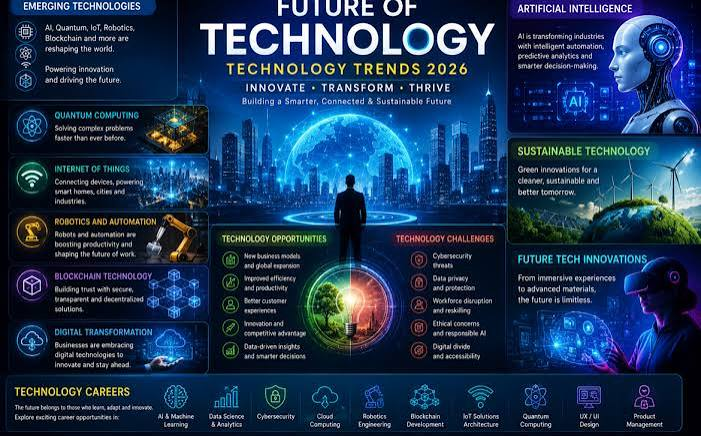
Technology continues to evolve at an extraordinary pace in 2026, transforming the way people work, communicate, shop and access information. Artificial intelligence, cloud computing, cybersecurity, smart devices and digital services are becoming increasingly important across almost every industry.
What makes the current technology landscape different is the speed at which new tools are moving from research laboratories into everyday products. Businesses are adopting AI to improve productivity, consumers are using intelligent digital assistants and technology companies are investing heavily in infrastructure to support the next generation of digital services.
Artificial Intelligence Remains the Biggest Technology Trend
Artificial intelligence continues to dominate the technology industry in 2026.
AI is increasingly being integrated into smartphones, computers, search platforms, business software and online services. Instead of simply answering questions, newer AI systems can help users organize information, generate content, analyze data and complete increasingly complex tasks.
Businesses are also using AI to automate repetitive work, improve customer service and support decision-making. Industries including finance, healthcare, retail, manufacturing and transportation are exploring ways to use AI more effectively.
The growing adoption of AI is creating demand for powerful processors, data centers, cloud infrastructure and specialized software. This means the impact of AI extends far beyond companies that directly develop AI applications.
AI Agents Could Change How People Use Software
One of the emerging developments in artificial intelligence is the rise of AI agents.
Traditional software usually requires users to complete a series of individual steps. AI agents are designed to understand a goal and potentially perform multiple tasks with less direct instruction.
For example, an AI system could help organize information, compare options, prepare documents or manage routine business processes.
The technology is still developing, and questions about reliability, security and human oversight remain important. However, AI agents could significantly change the relationship between people and software if they become reliable enough for widespread use.
Smartphones Are Becoming More Intelligent
Smartphones remain central to the digital economy, but their role is changing as manufacturers integrate more AI features.
Modern devices can increasingly perform tasks such as image enhancement, language translation, voice recognition and personalized recommendations directly on the device.
On-device AI can provide advantages because certain tasks can be completed without sending all information to remote servers. This may improve response times and potentially provide additional privacy benefits.
At the same time, smartphone manufacturers continue to compete on camera quality, battery life, displays, processing power and connectivity.
Cloud Computing Continues to Power Digital Growth
Cloud computing remains a critical part of the modern technology ecosystem.
Companies use cloud platforms to store data, run applications and access computing resources without maintaining all of their own physical infrastructure.
The growth of artificial intelligence is increasing demand for cloud computing because advanced AI systems require significant processing power and data-storage capacity.
Cloud technology is also helping small and medium-sized businesses access sophisticated software and infrastructure that was once available mainly to large corporations.
Cybersecurity Is Becoming More Important
As businesses and consumers become more dependent on digital services, cybersecurity has become one of the most important technology priorities.
Cyberattacks can target businesses, government organizations and individuals. Threats can include phishing, ransomware, identity theft and attempts to gain unauthorized access to sensitive information.
Artificial intelligence is being used on both sides of the cybersecurity challenge. Security teams can use AI to identify unusual activity and analyze large amounts of data, while attackers can potentially use automated tools to make certain attacks more sophisticated.
This means organizations must continuously improve their security systems rather than treating cybersecurity as a one-time investment.
Strong passwords, multi-factor authentication, software updates and employee training remain important defenses for businesses and individuals.
Smart Homes Are Becoming More Connected
The smart-home market continues to expand as connected devices become more affordable and easier to use.
Smart thermostats, security cameras, lighting systems, door locks and household appliances can be connected through mobile applications and centralized platforms.
AI is also making smart homes more responsive. Systems can potentially learn household routines and automate certain activities based on preferences.
However, connected devices also create new privacy and security concerns. Consumers should carefully review device permissions and keep software updated to reduce potential security risks.
Robotics and Automation Are Expanding
Robotics is another area receiving significant attention.
Manufacturers have used industrial robots for years, but advances in AI and machine learning are expanding the capabilities of automated systems.
Robots are increasingly being explored for logistics, manufacturing, healthcare, agriculture and other applications.
The combination of robotics and AI could allow machines to operate in more complex environments and perform tasks that previously required extensive human supervision.
Rather than eliminating every human role, automation is likely to change the nature of many jobs. Workers may increasingly focus on tasks requiring creativity, communication, judgment and specialized knowledge.
Technology Is Changing the Workplace
The workplace is also being transformed by digital tools.
Remote collaboration platforms, cloud software and AI assistants allow employees to work across locations and automate routine activities.
Companies are increasingly focused on how technology can improve productivity rather than simply adding more software.
This creates a growing need for digital skills. Employees who understand how to work effectively with AI and modern technology may have an advantage in an increasingly digital job market.
Businesses are therefore investing more attention in training and workforce development.
Green Technology Is Gaining Momentum
Technology is also playing a role in efforts to improve energy efficiency and reduce environmental impact.
Renewable-energy systems, electric vehicles, energy-storage technology and smart power-management systems continue to develop.
Data centers supporting AI and cloud computing are also increasing demand for electricity, creating greater interest in efficient computing and cleaner energy sources.
The technology industry therefore faces a dual challenge: expanding digital infrastructure while managing its environmental footprint.
The Future of Technology
The next stage of technological development is likely to involve greater integration.
AI will become part of more applications and devices. Cloud platforms will continue supporting digital services, while smart devices and connected systems will become more common.
At the same time, cybersecurity, privacy and responsible technology development will become increasingly important.
The companies that succeed may not simply be those with the most advanced technology. They will be the organizations that can turn technology into useful, secure and reliable products that solve real problems.
Conclusion
Technology in 2026 is being shaped by artificial intelligence, cloud computing, cybersecurity, robotics, smart devices and digital transformation.
AI remains the central force behind many of these developments, but its impact extends into nearly every part of the economy. Businesses are using technology to improve productivity, while consumers are gaining access to increasingly intelligent digital products.
The coming years are likely to bring even greater technological change. As innovation accelerates, society will need to balance the benefits of new technology with responsible development, privacy protection and cybersecurity.
For businesses and consumers alike, the ability to understand and adapt to these changes will be one of the most important advantages in the digital age.