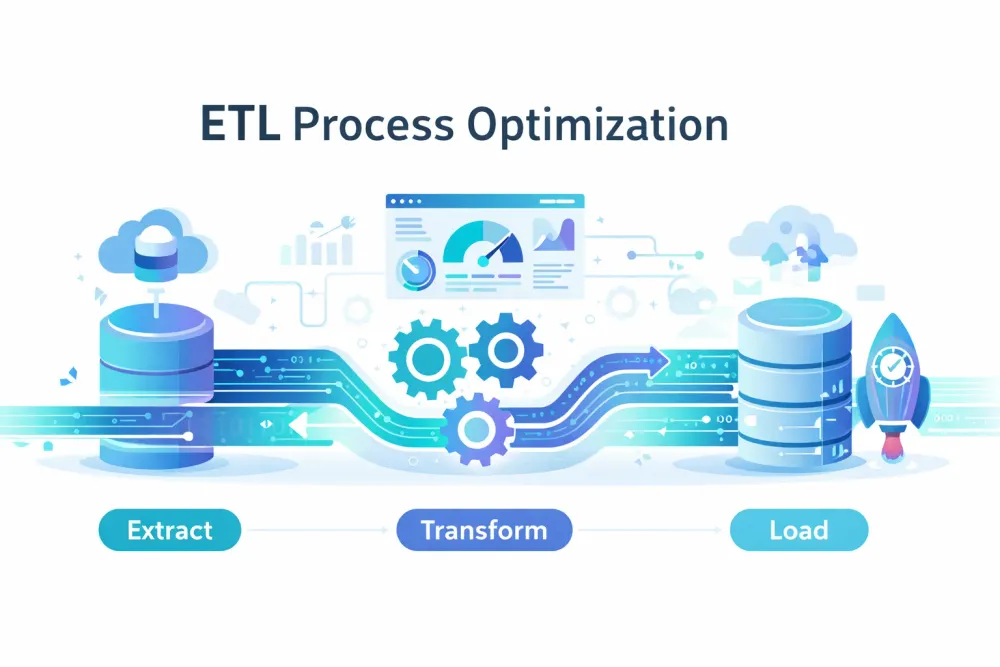
Modern organizations rely on data to make informed decisions, improve customer experiences, and streamline business operations. Every day, businesses collect information from websites, mobile applications, enterprise systems, cloud services, and third-party platforms. However, raw data is often incomplete, inconsistent, or stored in different formats, making it unsuitable for direct analysis. This is why ETL Process Optimization plays a vital role in building efficient data pipelines that deliver accurate and timely information for reporting and business intelligence.
What Is an ETL Data Pipeline?
An ETL data pipeline is a workflow that extracts data from multiple sources, transforms it into a consistent and usable format, and loads it into a centralized destination such as a data warehouse or data lake. This process ensures that data from different systems can be combined and analyzed effectively.
A typical ETL pipeline consists of three stages:
- Extract: Collect data from various source systems.
- Transform: Clean, validate, standardize, and enrich the data.
- Load: Store the processed data in a target database or warehouse.
Well-designed ETL pipelines enable organizations to maintain reliable datasets while supporting analytics, dashboards, and machine learning applications.
Why Data Pipeline Performance Matters
As businesses generate larger volumes of data, pipeline performance becomes increasingly important. Slow or inefficient ETL workflows can delay reports, increase operational costs, and negatively affect business decisions.
An optimized data pipeline offers several benefits:
- Faster data availability
- Improved reporting accuracy
- Better resource utilization
- Lower maintenance costs
- Increased scalability
- Higher system reliability
- Enhanced user satisfaction
Improving pipeline performance ensures that decision-makers have access to fresh and accurate information whenever they need it.
Design Efficient Data Pipelines
Performance begins with a well-planned architecture. Complex workflows containing unnecessary steps often consume excessive computing resources.
To build efficient ETL pipelines:
- Keep workflows simple and modular.
- Separate extraction, transformation, and loading tasks.
- Avoid duplicate processing.
- Reuse existing transformation logic whenever possible.
- Document every pipeline for easier maintenance.
A clean architecture improves both performance and long-term scalability.
Use Incremental Data Processing
One of the most effective optimization strategies is incremental processing. Instead of processing an entire dataset every time a job runs, incremental processing handles only records that have changed since the previous execution.
Benefits include:
- Reduced processing time
- Lower server workload
- Faster report generation
- Reduced storage requirements
- Improved system efficiency
Techniques such as timestamps, change data capture (CDC), and version tracking make incremental processing easier to implement.
Optimize SQL Queries
Many ETL pipelines rely heavily on SQL queries during extraction and transformation. Poorly written queries often become major performance bottlenecks.
Best practices include:
- Select only required columns.
- Avoid unnecessary joins.
- Use indexed fields in filtering conditions.
- Limit returned rows whenever possible.
- Analyze query execution plans regularly.
Efficient SQL design can significantly reduce processing times and improve overall pipeline performance.
Improve Transformation Efficiency
The transformation stage often consumes the largest share of ETL execution time because it applies business rules and data validation.
Several techniques can improve efficiency:
Simplify Business Logic
Complex transformation rules require additional processing. Review workflows regularly and eliminate unnecessary calculations.
Process Data in Parallel
Independent transformation tasks can run simultaneously on multiple processors or servers, reducing overall execution time.
Standardize Data Formats
Consistent formats for dates, currencies, and identifiers reduce conversion overhead and simplify downstream analysis.
Minimize Data Conversion
Repeated conversions between data types increase processing costs. Convert data only when necessary.
Optimize Data Loading
Loading data efficiently into the destination system is just as important as extraction and transformation.
Recommended practices include:
Bulk Inserts
Bulk loading is much faster than inserting records individually, especially for large datasets.
Batch Transactions
Loading data in manageable batches reduces memory usage and simplifies rollback operations if failures occur.
Partition Large Tables
Partitioning large warehouse tables improves loading speed while also enhancing query performance.
Disable Constraints During Large Loads
Temporarily disabling certain indexes or constraints during bulk loading can increase insertion speed. These should be rebuilt after loading completes.
Improve Data Quality
High-quality data leads to better analytics and reduces processing overhead.
Organizations should validate:
- Duplicate records
- Missing values
- Invalid formats
- Inconsistent units
- Incorrect data types
- Business rule violations
Implementing validation early in the ETL process prevents errors from spreading throughout downstream systems.
Automate Workflow Scheduling
Automation improves consistency while reducing manual intervention.
Modern ETL scheduling systems allow organizations to:
- Schedule recurring jobs
- Trigger workflows automatically
- Handle dependencies between tasks
- Retry failed jobs
- Send alerts when errors occur
Automation ensures that pipelines operate reliably even as workloads increase.
Monitor Pipeline Performance
Continuous monitoring is essential for identifying performance issues before they affect users.
Important metrics include:
- Job execution time
- CPU utilization
- Memory consumption
- Network throughput
- Data volume processed
- Failure rates
- Queue waiting time
Real-time monitoring enables administrators to detect bottlenecks and respond quickly.
Utilize Cloud-Based ETL Platforms
Cloud technologies have transformed modern data integration by providing flexible infrastructure and scalable processing power.
Advantages of cloud ETL include:
- Automatic scaling
- Reduced infrastructure management
- High availability
- Pay-as-you-go pricing
- Global accessibility
Cloud-native platforms are particularly useful for organizations processing rapidly growing datasets.
Strengthen Security and Compliance
Data pipelines often handle sensitive customer, financial, or operational information. Security should be integrated into every stage of the ETL process.
Important security practices include:
- Encrypt data during transmission and storage.
- Implement role-based access control.
- Monitor user activity.
- Protect API credentials.
- Regularly audit pipeline configurations.
Strong security measures help organizations meet regulatory requirements while protecting valuable business data.
Reduce Operational Costs
Efficient ETL pipelines not only improve performance but also reduce operational expenses.
Cost-saving strategies include:
- Eliminating redundant processing
- Using incremental loads
- Compressing data before transfer
- Archiving inactive datasets
- Optimizing cloud resource usage
Lower processing costs allow organizations to scale data operations more effectively.
Future of ETL Optimization
The future of ETL is being shaped by emerging technologies that improve automation and performance.
Key trends include:
- Artificial intelligence for workload optimization
- Machine learning–based anomaly detection
- Real-time streaming data pipelines
- Serverless ETL architectures
- Automated data quality management
These innovations enable organizations to process larger datasets with greater speed, reliability, and efficiency.
Conclusion
Optimizing ETL data pipelines is essential for organizations that depend on timely, accurate, and reliable information. By designing efficient workflows, implementing incremental processing, optimizing SQL queries, improving transformations, automating scheduling, monitoring performance, and leveraging cloud technologies, businesses can significantly enhance pipeline performance. As data volumes continue to grow, investing in effective optimization strategies ensures that ETL systems remain scalable, cost-effective, and capable of supporting modern analytics and business intelligence initiatives.

DNS Magazine News Admin shares informative and engaging content covering technology, business, lifestyle, digital marketing, and trending topics. Our goal is to provide readers with useful, reliable, and easy-to-understand information.