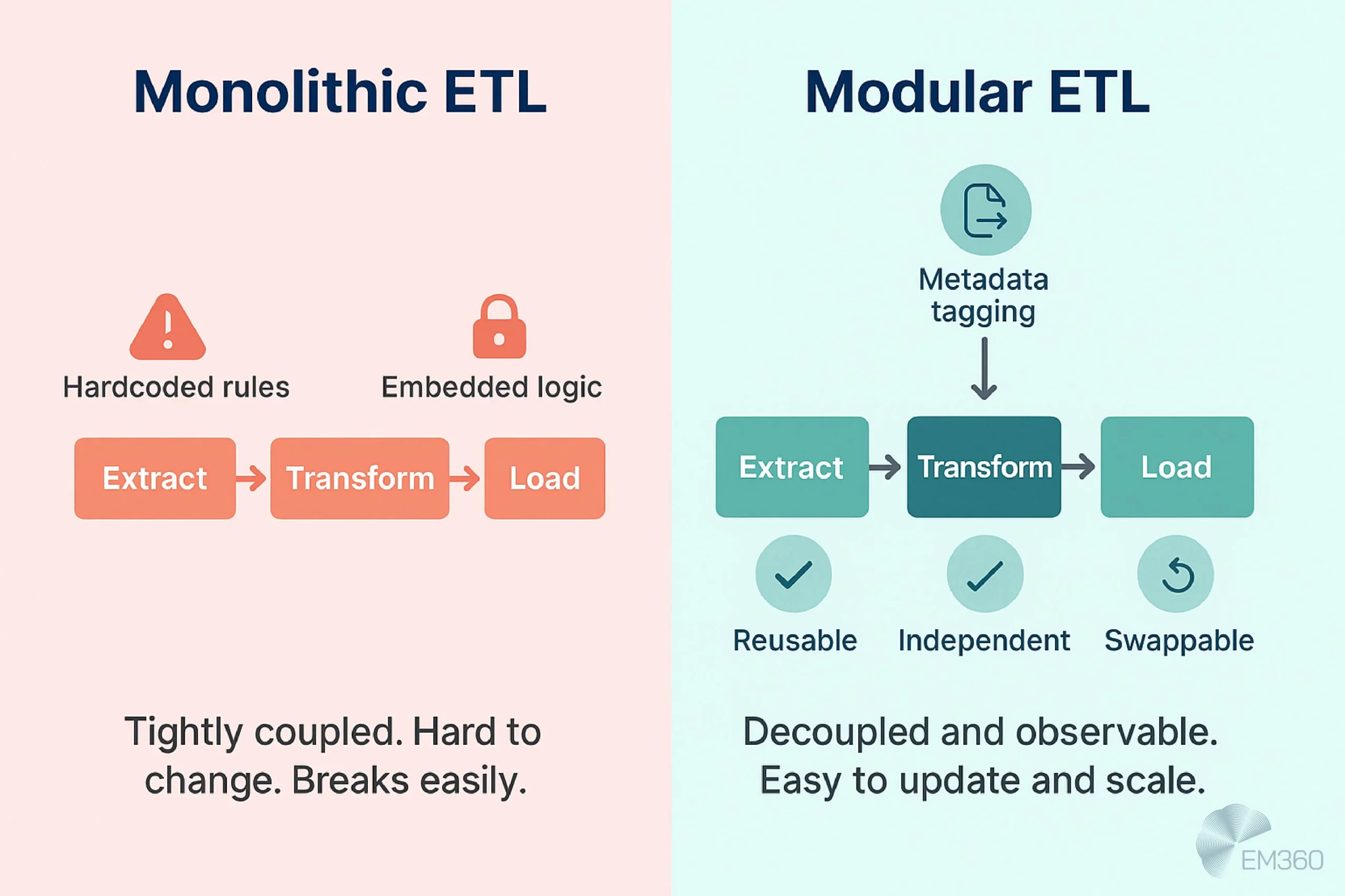
In the age of big data, organizations depend on accurate and timely information to make informed business decisions. Data is collected from multiple sources, including databases, cloud applications, websites, APIs, and enterprise systems. However, raw data is often inconsistent, incomplete, or duplicated, making it unsuitable for analysis. This is where ETL (Extract, Transform, Load) plays a crucial role. ETL helps organizations collect, clean, transform, and store data in a structured format that supports reporting and business intelligence.
To maximize the efficiency of ETL workflows, businesses must adopt proven strategies that enhance data quality and system performance. By implementing ETL Best Practices, organizations can reduce processing errors, improve reliability, and create scalable data integration pipelines that support long-term growth.
Understanding the ETL Process
ETL is a structured process that prepares data for analysis by moving it from various source systems into a centralized repository.
The process includes three key stages:
- Extract: Collect data from different sources such as relational databases, cloud services, spreadsheets, APIs, and CRM platforms.
- Transform: Clean, validate, standardize, and enrich the extracted data to meet business requirements.
- Load: Store the transformed data in a data warehouse, data lake, or analytics platform where it can be accessed for reporting and decision-making.
Each stage contributes to the overall quality and reliability of business data.
Why Data Quality Matters
Data quality directly affects the accuracy of business reports and analytics. Poor-quality data can lead to incorrect forecasts, inefficient operations, and poor customer experiences.
High-quality data provides several benefits, including:
- Better decision-making
- Accurate reporting
- Improved customer insights
- Higher operational efficiency
- Increased trust in business intelligence
Maintaining clean and consistent data should be a top priority for every organization.
Plan Your ETL Workflow Carefully
Before building an ETL pipeline, it is important to understand the organization’s goals and data requirements.
Key planning considerations include:
- Identifying all data sources
- Defining the destination system
- Understanding data volume
- Determining update frequency
- Establishing validation rules
- Planning for future scalability
A well-designed workflow reduces development time and simplifies ongoing maintenance.
Validate Data During Extraction
Many organizations focus only on transformation, but validation should begin during extraction.
Useful validation techniques include:
- Checking file formats
- Verifying record counts
- Detecting missing values
- Identifying duplicate records
- Confirming source availability
Early validation prevents invalid data from entering later stages of the pipeline.
Standardize Data Formats
Different systems often store information using different formats.
For example:
- Dates may appear as MM/DD/YYYY or DD/MM/YYYY.
- Currency values may use different symbols.
- Customer names may follow inconsistent capitalization.
Standardizing these formats ensures consistency across reports and analytics systems.
Optimize Data Transformation
Transformation is often the most resource-intensive part of ETL. Efficient transformation logic improves overall performance while reducing system load.
Optimization strategies include:
- Removing unnecessary calculations
- Reusing transformation rules
- Breaking complex workflows into smaller tasks
- Using optimized SQL queries
- Eliminating redundant processing
Simple transformation logic is easier to maintain and performs more efficiently.
Use Incremental Loading
Instead of loading complete datasets during every execution, organizations should load only new or modified records whenever possible.
Incremental loading offers several advantages:
- Faster execution
- Lower storage requirements
- Reduced network traffic
- Less impact on source systems
- Improved scalability
This approach is especially beneficial for organizations managing millions of records.
Automate ETL Pipelines
Automation improves consistency while reducing manual effort.
Automated ETL workflows can:
- Execute on scheduled intervals
- Trigger automatically after data updates
- Retry failed jobs
- Send email notifications
- Generate execution reports
Automation reduces human error and ensures that business data remains up to date.
Monitor Performance Continuously
Even well-designed ETL pipelines require ongoing monitoring.
Important performance metrics include:
- Job completion time
- Data processing speed
- Failed records
- Resource utilization
- Query execution time
- Error frequency
Regular monitoring helps identify performance bottlenecks before they affect business operations.
Implement Strong Error Handling
Unexpected errors are unavoidable in any ETL environment. Network interruptions, corrupted files, or unexpected schema changes can cause workflow failures.
Effective error handling should include:
- Detailed logging
- Automatic retry mechanisms
- Failure notifications
- Exception tracking
- Backup recovery procedures
Instead of stopping the entire pipeline, organizations should isolate problematic records while allowing valid data to continue processing.
Protect Sensitive Information
Modern ETL systems often process confidential customer information, financial records, healthcare data, and internal business documents.
To improve security:
- Encrypt data during transfer
- Encrypt sensitive stored data
- Implement role-based access control
- Use secure authentication methods
- Maintain audit logs
- Follow regulatory compliance standards
Strong security measures protect both organizational assets and customer trust.
Design Scalable ETL Pipelines
Business data continues to grow every year. ETL systems should be built to accommodate future expansion without requiring significant redesign.
Scalable ETL architectures support:
- Cloud computing
- Distributed processing
- Parallel execution
- Modular workflows
- Automatic resource scaling
Planning for scalability ensures long-term performance as workloads increase.
Maintain Comprehensive Documentation
Documentation simplifies maintenance and supports collaboration among development teams.
Every ETL project should document:
- Data sources
- Destination systems
- Transformation rules
- Workflow schedules
- Validation procedures
- Security policies
- Version history
Updated documentation helps new team members understand existing workflows quickly.
Test Before Deployment
Testing ensures that ETL Best Practices pipelines produce accurate and reliable results.
Recommended testing includes:
- Functional testing
- Integration testing
- Performance testing
- Data validation
- Security testing
- User acceptance testing
Regular testing minimizes production issues and improves system stability.
Continuously Improve Your ETL Process
Technology evolves rapidly, and ETL workflows should evolve as well.
Organizations should regularly:
- Review pipeline performance
- Update transformation logic
- Improve SQL queries
- Remove obsolete workflows
- Upgrade ETL tools
- Implement new automation features
Continuous improvement helps maintain efficiency while supporting changing business requirements.
Conclusion
Building reliable ETL pipelines requires careful planning, continuous monitoring, strong security, and a commitment to maintaining high-quality data. Organizations that focus on validation, automation, scalability, and performance optimization can significantly improve their data integration processes. By following ETL Best Practices, businesses create efficient workflows that deliver clean, accurate, and timely information for reporting and analytics.

DNS Magazine News Admin shares informative and engaging content covering technology, business, lifestyle, digital marketing, and trending topics. Our goal is to provide readers with useful, reliable, and easy-to-understand information.