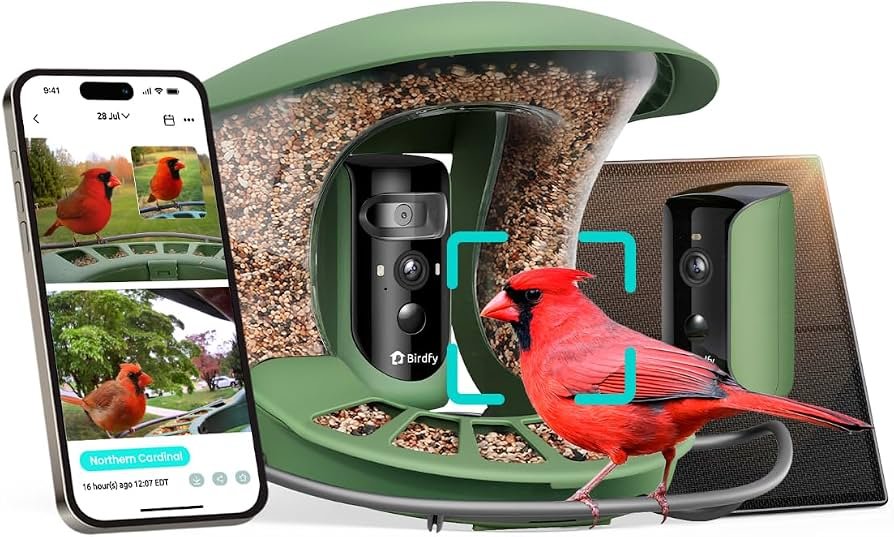
A camera feeder on a windowsill can bring the same calming, attention restoring effect as a walk outside, opening nature based therapy to people who cannot easily leave a room.
Walk through UF’s campus in early spring and you might catch a bald eagle circling over the Health Science Center, or a great egret settling near Lake Alice at sunrise. The university’s Health Humanities and Nature Based Therapies guide has been tracking these small moments for years, from osprey sightings to student trips out to Sweetwater Wetlands Park. There is a reason a library guide bothers cataloguing bird sightings alongside poetry therapy and narrative medicine resources. Watching birds does something to the nervous system that most people only half notice until someone points it out. And now, a growing number of people are getting that same effect from a small camera mounted just outside a window, no walk required at all.
Why Watching Birds Calms People Down in the First Place
The science behind this goes back further than most people expect. Psychologists Rachel and Stephen Kaplan at the University of Michigan described two kinds of attention decades ago. One is the effortful, task focused kind we use all day at work or school, and it wears us down. The other is called soft fascination, the kind of loose, effortless attention that nature pulls out of us without asking. Watching a bird hop between branches or pause on a feeder uses exactly that second kind, and it gives the first kind a chance to rest.
That is not just theory anymore. A study reported by Scientific Reports discovered that either watching or listening to birds throughout one’s day improved the mental well-being of participants, even those suffering from depression. In another study conducted with the help of an application called Urban Mind, where over 1,200 people participated, a similar result was found among people whether they had a mood disorder diagnosis or not. Just spotting a bird made a difference.
What This Looks Like on a College Campus
Students carry a lot right now. National surveys have found that around 60 percent of college students report some kind of mental health challenge, and the numbers have not really come down since the pandemic. A pilot study looking specifically at birdwatching on college campuses found that a guided birding walk increased measures of psychological well being and reduced distress more than a typical nature walk without any bird focus. Something about the act of watching and identifying a specific animal, rather than just being outside in general, seems to matter.
This lines up with what UF’s own Health Humanities Pathway has been doing informally through campus bird walks and trips to nearby wetlands. Students do not need a diagnosis or a referral to take part. They just need a reason to stop and look up.
Extending the Same Benefit to Seniors and Rehabilitation Settings
Not everyone can take a guided walk, though. Those who reside in nursing homes, are recovering from surgery, or are confined in other ways cannot access nature-based therapies since these activities normally assume mobility and ability to be outdoors for some time. Studies conducted with nursing home residents practicing birdwatching demonstrated significant changes in their state of mind and increased engagement even in cases when the participants had serious physical disabilities.
This is where a camera feeder becomes more than just a nice accessory to have. A device such as Birdfy is placed outside a window and identifies any bird that landed on it and transmits the image directly to the monitor indoors. This way, those in rehab centers or special units for dementia patients will experience the same soothing effect described by Kaplans, but without leaving the room. No coat, no walk, no help getting outside required. The barrier that used to keep the most vulnerable people out of nature therapy quietly disappears.
Lowering the Barrier Without Losing the Point
There is a fair worry here worth naming directly: does watching a bird on a screen actually count, or does it just feel like watching television with better lighting. So far, the research indicates that the crucial aspect is the act of identifying and tracking a living animal, rather than being under a tree or inside somewhere. A camera bird feeder manages to maintain that act of identification, tracking, and observing intact even if one cannot move from the room. It still identifies the species; it still showcases real behavior; it still provides one with something alive to observe rather than just a generic nature documentary.
That distinction is exactly the kind of question health humanities scholars are suited to ask. The field has always sat at the point where humanities thinking meets clinical practice, weighing not just whether something works but what it means for a patient’s actual experience of care. A bird on a screen and a bird on a branch are not identical experiences, but the growing body of research suggests they may share more of the same restorative core than most people would guess.
Where This Leaves Nature Based Therapy at UF
None of this replaces a walk to Sweetwater Wetlands Park, and nobody involved in health humanities work would suggest it should. What smart bird feeders actually offer is an entry point for people who currently have no entry point at all, a senior citizen who cannot manage stairs, a patient tethered to equipment, a student too anxious to leave their dorm on a bad week. As UF continues building out its nature and healing programs, technology like this deserves a seat at the table, not as a replacement for the outdoors, but as a bridge to it for the people who need one most.

DNS Magazine News Admin shares informative and engaging content covering technology, business, lifestyle, digital marketing, and trending topics. Our goal is to provide readers with useful, reliable, and easy-to-understand information.