Data has become one of the most valuable assets for modern businesses. Organizations collect information from websites, mobile applications, cloud platforms, customer relationship management systems, and countless other sources. However, raw data is rarely ready for analysis. It often contains duplicate entries, missing values, inconsistent formats, and outdated information. ETL (Extract, Transform, Load) is the process that converts this raw data into meaningful, reliable information that supports business intelligence and decision-making.
Although ETL is a well-established process, many organizations struggle with slow pipelines, poor data quality, and maintenance challenges. By following ETL Best Practices, businesses can avoid common mistakes, improve system performance, and build efficient data pipelines that deliver accurate and timely insights.
What Is ETL?
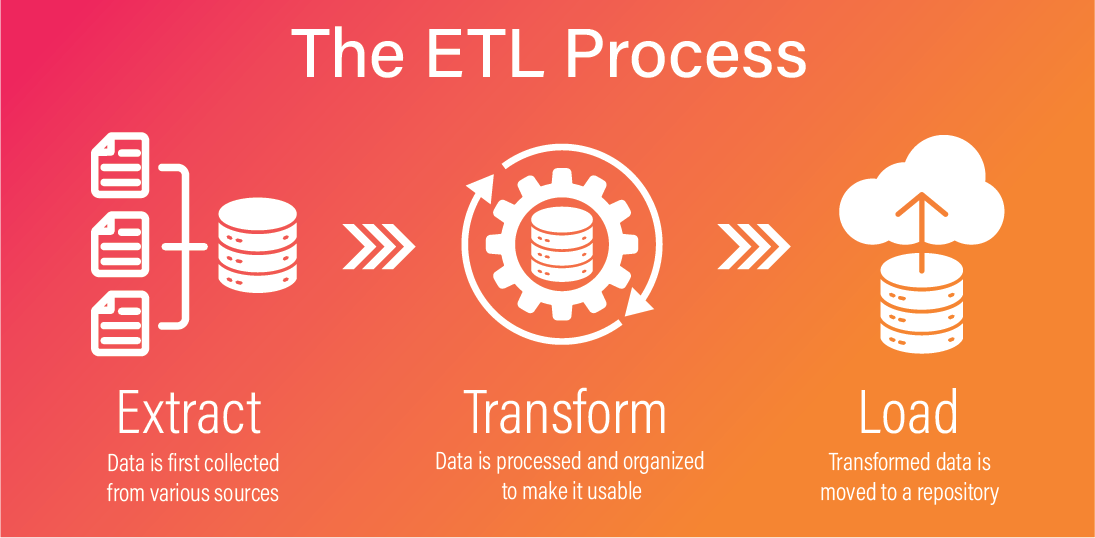
ETL stands for Extract, Transform, and Load. It is a structured method of collecting data from multiple sources, converting it into a consistent format, and storing it in a centralized location such as a data warehouse or data lake.
The ETL process consists of three stages:
- Extract: Gather data from various systems, databases, APIs, spreadsheets, and cloud applications.
- Transform: Clean, validate, organize, and enrich the extracted data according to business rules.
- Load: Store the transformed data in a destination system where analysts and business users can access it.
When designed properly, ETL pipelines ensure that organizations work with reliable and consistent information.
Why ETL Success Matters
A successful ETL process directly impacts reporting accuracy, operational efficiency, and business decision-making. Poor ETL workflows can produce inaccurate reports, delay analytics, and increase maintenance costs.
Well-designed ETL pipelines provide several benefits:
- Higher data quality
- Faster processing
- Better scalability
- Improved reporting accuracy
- Reduced operational costs
- Greater business confidence
These advantages help organizations make informed decisions based on trustworthy information.
Common Mistake 1: Ignoring Data Quality
One of the biggest ETL mistakes is assuming that source data is already accurate. In reality, raw data often contains duplicate records, missing values, incorrect formatting, and inconsistent naming conventions.
To improve data quality:
- Validate incoming records.
- Remove duplicate data.
- Standardize formats.
- Verify mandatory fields.
- Apply business validation rules.
Improving data quality early prevents errors from spreading throughout the pipeline.
Common Mistake 2: Poor Planning
Many ETL projects begin without clearly defined business objectives. As a result, workflows become difficult to maintain and often require major redesigns.
Before building an ETL pipeline, identify:
- Data sources
- Destination systems
- Processing frequency
- Business requirements
- Security needs
- Expected data volume
A solid plan creates a strong foundation for long-term success.
Common Mistake 3: Loading Full Data Every Time
Loading complete datasets during every execution wastes system resources and increases processing time.
Instead, organizations should use incremental loading whenever possible.
Incremental loading processes only new or modified records, providing several benefits:
- Faster execution
- Lower storage requirements
- Reduced network traffic
- Better system performance
This approach becomes increasingly important as databases continue to grow.
Common Mistake 4: Overcomplicated Transformations
Complex transformation logic often slows ETL workflows and makes future maintenance more difficult.
Better approaches include:
- Simplifying business rules
- Breaking workflows into smaller modules
- Reusing transformation components
- Optimizing SQL queries
- Removing unnecessary calculations
Cleaner transformation logic improves both speed and maintainability.
Common Mistake 5: Lack of Automation
Manual ETL execution increases the risk of human error and consumes valuable time.
Modern ETL pipelines should automate:
- Job scheduling
- Data extraction
- Workflow execution
- Error notifications
- Report generation
- Retry mechanisms
Automation improves consistency while allowing technical teams to focus on higher-value activities.
Common Mistake 6: Weak Error Handling
Unexpected failures are unavoidable in ETL environments. Network outages, corrupted files, or source system changes can interrupt workflows.
Strong error handling should include:
- Detailed logging
- Automatic retries
- Alert notifications
- Exception tracking
- Backup recovery plans
A resilient pipeline isolates problematic records without stopping the entire process.
Common Mistake 7: Ignoring Performance Monitoring
Many organizations monitor ETL jobs only when problems occur. Continuous monitoring is a much better approach.
Important metrics include:
- Processing time
- Failed records
- CPU utilization
- Memory usage
- Query performance
- Data transfer speed
Regular monitoring helps identify bottlenecks before they impact business operations.
Common Mistake 8: Poor Security Practices
ETL pipelines often process confidential customer, financial, and operational data. Weak security can expose organizations to serious risks.
Security best practices include:
- Encrypting sensitive data
- Using secure authentication
- Implementing role-based access control
- Maintaining audit logs
- Following compliance regulations
Protecting sensitive information should remain a priority throughout the ETL lifecycle.
Proven Strategy 1: Build Scalable Pipelines
Business data continues to grow rapidly. ETL pipelines should support future expansion without requiring major redesign.
Scalable pipelines typically include:
- Cloud infrastructure
- Distributed processing
- Parallel execution
- Modular workflow design
- Flexible resource allocation
Scalability helps organizations adapt to changing business needs.
Proven Strategy 2: Document Everything
Comprehensive documentation makes ETL systems easier to maintain.
Documentation should include:
- Source systems
- Destination databases
- Transformation logic
- Workflow schedules
- Validation rules
- Security policies
- Version history
Good documentation reduces onboarding time and simplifies troubleshooting.
Proven Strategy 3: Test Thoroughly
Testing helps identify problems before ETL Best Practices pipelines reach production.
Recommended testing includes:
- Functional testing
- Integration testing
- Performance testing
- Data validation
- Security testing
- User acceptance testing
Regular testing improves reliability while reducing production failures.
Proven Strategy 4: Continuously Optimize
ETL systems should evolve alongside changing business requirements.
Continuous improvement involves:
- Updating transformation logic
- Improving SQL performance
- Reviewing execution times
- Removing obsolete workflows
- Upgrading ETL tools
- Expanding automation
Regular optimization keeps pipelines efficient even as data volumes increase.
Conclusion
A successful ETL pipeline requires more than simply moving data from one system to another. It demands careful planning, high-quality data validation, strong security, automation, scalability, and continuous monitoring. Organizations that avoid common ETL mistakes can significantly improve the speed, reliability, and accuracy of their data integration processes.

DNS Magazine News Admin shares informative and engaging content covering technology, business, lifestyle, digital marketing, and trending topics. Our goal is to provide readers with useful, reliable, and easy-to-understand information.