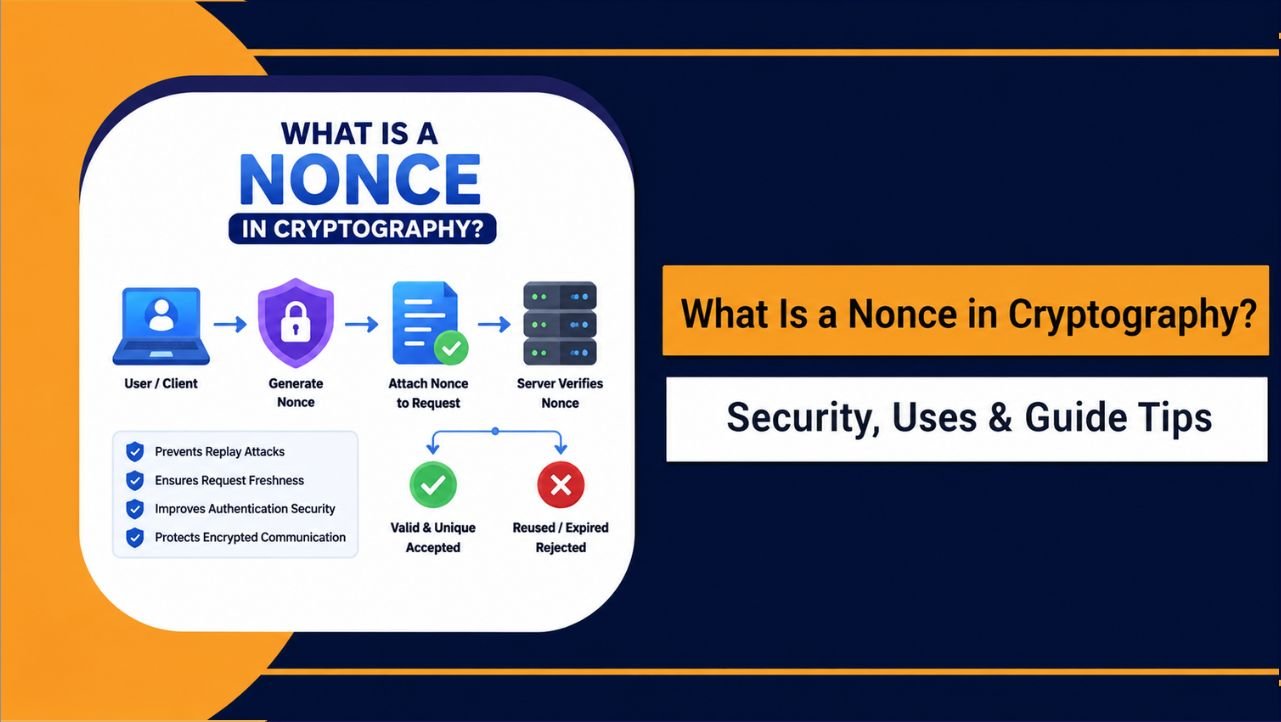
As technology continues to advance, cybersecurity has become more important than ever. Every day, people use online banking, social media, cloud storage, and e-commerce websites to perform activities that involve sharing sensitive information. Behind these digital services are advanced security systems designed to protect data from hackers and cybercriminals. One of the most important components of these systems is the nonce.
If you’re new to cryptography or cybersecurity, you’ve probably come across the question what is a nonce in security while reading about encryption, authentication, or blockchain technology. Although the term may sound complex, the concept is actually quite simple. A nonce is a unique value used only once during a cryptographic process to improve security and prevent attacks.
In this guide, you’ll learn everything you need to know about nonces in cryptography, including how they work, why they are important, where they are used, and the best practices for implementing them.
Understanding the Meaning of a Nonce
The word “nonce” comes from the phrase “number used once.” In cybersecurity, a nonce is a randomly generated or sequential value that is used for a single cryptographic operation.
Unlike passwords, encryption keys, or secret tokens, a nonce does not need to remain confidential. Its purpose is to ensure that every message, request, or transaction is unique. Once a nonce has been used successfully, it should never be reused with the same cryptographic key.
This uniqueness helps prevent attackers from copying and reusing valid communications.
What Is a Nonce in Security?
If you’re asking what is a nonce in security, the answer is straightforward. A nonce is a one-time-use value generated during encryption or authentication to ensure that every communication is unique and protected from replay attacks. Whether generated randomly or sequentially, a nonce helps verify that requests are fresh, authentic, and have not been reused by attackers.
Because every nonce is different, even identical data can produce completely different encrypted outputs.
Why Are Nonces Important?
Modern cybersecurity depends on ensuring that digital communications cannot simply be copied and reused.
Without a nonce, hackers could intercept an authenticated request and resend it later to gain unauthorized access or duplicate transactions.
A nonce solves this problem by making every communication unique.
Some of its major benefits include:
- Preventing replay attacks
- Improving authentication
- Strengthening encryption
- Protecting digital transactions
- Supporting secure APIs
- Enhancing blockchain security
- Increasing overall data protection
These benefits explain why nonces are included in many modern security protocols.
How Does a Nonce Work?
Let’s look at a simple example.
Suppose you log into your online banking account.
The process typically works like this:
- You enter your username and password.
- The server generates a unique nonce.
- The nonce is sent to your device.
- Your device combines the nonce with encrypted authentication data.
- The server validates the response.
- The nonce becomes invalid immediately after use.
If an attacker captures this communication and attempts to replay it later, the server rejects the request because the nonce has already been used.
How Nonces Prevent Replay Attacks
Replay attacks are among the most what is a nonce in security common threats addressed by nonces.
A replay attack occurs when a hacker records legitimate communication between two systems and later resends the same information.
For example:
Imagine you transfer money from your bank account.
Without nonce protection:
- The attacker copies the payment request.
- The same request is sent multiple times.
- Multiple unauthorized payments could occur.
With nonce protection:
- Every payment request contains a unique nonce.
- Previously used nonces are rejected.
- Duplicate transactions fail automatically.
This simple mechanism dramatically improves security.
Nonces in Cryptography
Cryptography relies heavily on randomness.
Many encryption algorithms use nonces to ensure identical plaintext never produces identical ciphertext.
Popular encryption methods that use nonces include:
- AES-GCM
- AES-CTR
- ChaCha20-Poly1305
- Authenticated Encryption with Associated Data (AEAD)
These encryption modes depend on unique nonces to maintain confidentiality and integrity.
Nonces in Authentication
Authentication systems generate nonces to verify that login attempts are new and legitimate.
Examples include:
- Internet banking
- Cloud computing platforms
- Corporate identity systems
- Government portals
- Multi-factor authentication (MFA)
Each authentication challenge contains a different nonce, preventing attackers from reusing intercepted login requests.
Nonces in API Security
Modern software applications communicate through APIs.
Secure APIs usually require every request to include:
- API key
- Timestamp
- Digital signature
- Nonce
The receiving server validates the nonce before processing the request.
If the nonce has already been used, the request is rejected immediately.
This helps prevent replay attacks and duplicate API calls.
Nonces in Blockchain Technology
Blockchain systems also rely on nonces.
In Bitcoin mining, miners repeatedly change the nonce value while calculating hashes.
The goal is to discover a nonce that produces a hash satisfying the network’s mining difficulty.
This process allows the blockchain to:
- Verify transactions
- Add new blocks
- Maintain consensus
- Secure the network
Without nonces, proof-of-work mining would not function.
Real-World Applications of Nonces
Nonces are used across countless digital systems.
Some common examples include:
Online Banking
Banks use nonces during login and transaction verification to prevent fraud.
E-Commerce Websites
Shopping websites generate nonces to secure payment requests and prevent duplicate purchases.
Cloud Services
Cloud providers authenticate API requests using nonce-based security.
Cryptocurrency Wallets
Wallet software relies on nonces to validate blockchain transactions.
Mobile Applications
Secure mobile apps use nonces during authentication and encrypted communication.
Secure Websites
HTTPS sessions often include nonce-based mechanisms within modern cryptographic protocols.
Best Practices for Using Nonces
Security professionals recommend following several best practices:
- Generate cryptographically secure random values.
- Never reuse a nonce with the same encryption key.
- Validate every incoming nonce.
- Set expiration times for nonce values.
- Store recent nonces temporarily to detect duplicates.
- Use secure random number generators.
Following these recommendations significantly improves cybersecurity.
Common Mistakes Developers Should Avoid
Even experienced developers can misuse nonces.
Common implementation mistakes include:
- Reusing nonce values
- Using predictable sequences
- Failing to validate incoming nonces
- Using weak random number generators
- Keeping nonces valid for too long
These mistakes can reduce the effectiveness of encryption and authentication systems.
Why Nonces Matter for the Future
As technologies such as cloud computing, artificial intelligence (AI), the Internet of Things (IoT), and decentralized finance (DeFi) continue to evolve, the demand for secure communication will only increase. Nonces play a critical role in protecting these technologies by ensuring that every request, message, or transaction remains unique.
Developers and security professionals continue to rely on nonce-based cryptographic techniques because they provide an effective defense against many common cyber threats without adding unnecessary complexity.
Conclusion
Understanding what is a nonce in security is essential for anyone interested in cybersecurity, networking, or cryptography. A nonce is a simple one-time-use value, but its impact on digital security is enormous. It prevents replay attacks, strengthens encryption, improves authentication, protects APIs, and supports blockchain operations.

DNS Magazine News Admin shares informative and engaging content covering technology, business, lifestyle, digital marketing, and trending topics. Our goal is to provide readers with useful, reliable, and easy-to-understand information.