Modern businesses rely on data to support analytics, reporting, forecasting, automation, and everyday decision-making. As organizations collect information from databases, APIs, applications, cloud platforms, and other systems, they need reliable processes to move and prepare that data.
ETL, which stands for Extract, Transform, and Load, provides a structured approach for collecting data from different sources, transforming it into a useful format, and loading it into a destination such as a data warehouse or analytics platform.
However, simply creating an ETL pipeline is not enough. Data engineers need to consider quality, security, performance, and scalability from the beginning. Applying effective etl best practices can help organizations build reliable pipelines that continue to perform as data requirements grow.
What Is ETL?
ETL is a data integration process consisting of three primary stages.
Extract: Data is collected from sources such as databases, APIs, files, applications, and cloud services.
Transform: The extracted information is cleaned, validated, standardized, filtered, and converted according to business requirements.
Load: The processed data is stored in a target system where it can be used for analytics, reporting, machine learning, or other applications.
Each stage needs to be carefully designed because problems in one stage can affect the entire data pipeline.
1. Focus on Data Quality
Data quality is one of the most important considerations when developing an ETL pipeline. Inaccurate, incomplete, or duplicated information can lead to incorrect reports and poor business decisions.
Data quality checks should be performed throughout the pipeline. Common validation activities include checking for:
- Missing values
- Duplicate records
- Invalid data types
- Incorrect formats
- Unexpected values
- Broken relationships
- Incomplete records
Automating these checks allows engineers to identify problems early and prevent unreliable information from reaching downstream systems.
2. Standardize Data During Transformation
Data collected from different sources often uses inconsistent formats. One system may store dates differently from another, while customer names, addresses, or product information may follow different conventions.
Transformation rules should standardize these differences before data is loaded into the destination.
For example, engineers can standardize date formats, convert data types, normalize text values, and apply consistent naming conventions.
Standardized data is easier to analyze and combine across multiple systems.
3. Protect Sensitive Data
Security should be built into every stage of an ETL workflow. Data pipelines may process confidential customer information, financial records, business data, or other sensitive information.
Organizations should use appropriate security controls such as:
- Encryption
- Authentication
- Role-based access
- Secure credential storage
- Network security
- Access monitoring
Passwords and API keys should never be stored directly inside ETL scripts. Secure credential management solutions should be used instead.
4. Minimize Unnecessary Data Movement
Moving large amounts of unnecessary data can slow down pipelines and increase infrastructure costs.
Engineers should extract only the information required for the business process. Filtering records and selecting necessary columns at the source can reduce network traffic and processing requirements.
This approach can improve performance while also reducing storage and operational costs.
5. Use Incremental Loading
Processing an entire dataset during every pipeline execution is often inefficient. Incremental loading allows the pipeline to process only new or changed records.
Common approaches include:
- Timestamp-based processing
- Change data capture
- Transaction IDs
- Version numbers
- Modification flags
Incremental loading is especially useful for large datasets because it reduces the amount of data that must be processed during each run.
6. Optimize Transformation Performance
Complex transformations can become performance bottlenecks when working with large datasets.
To improve performance, engineers should avoid unnecessary calculations, reduce repeated operations, filter data early, and optimize database queries.
For computationally intensive workloads, distributed processing can allow multiple resources to process data simultaneously.
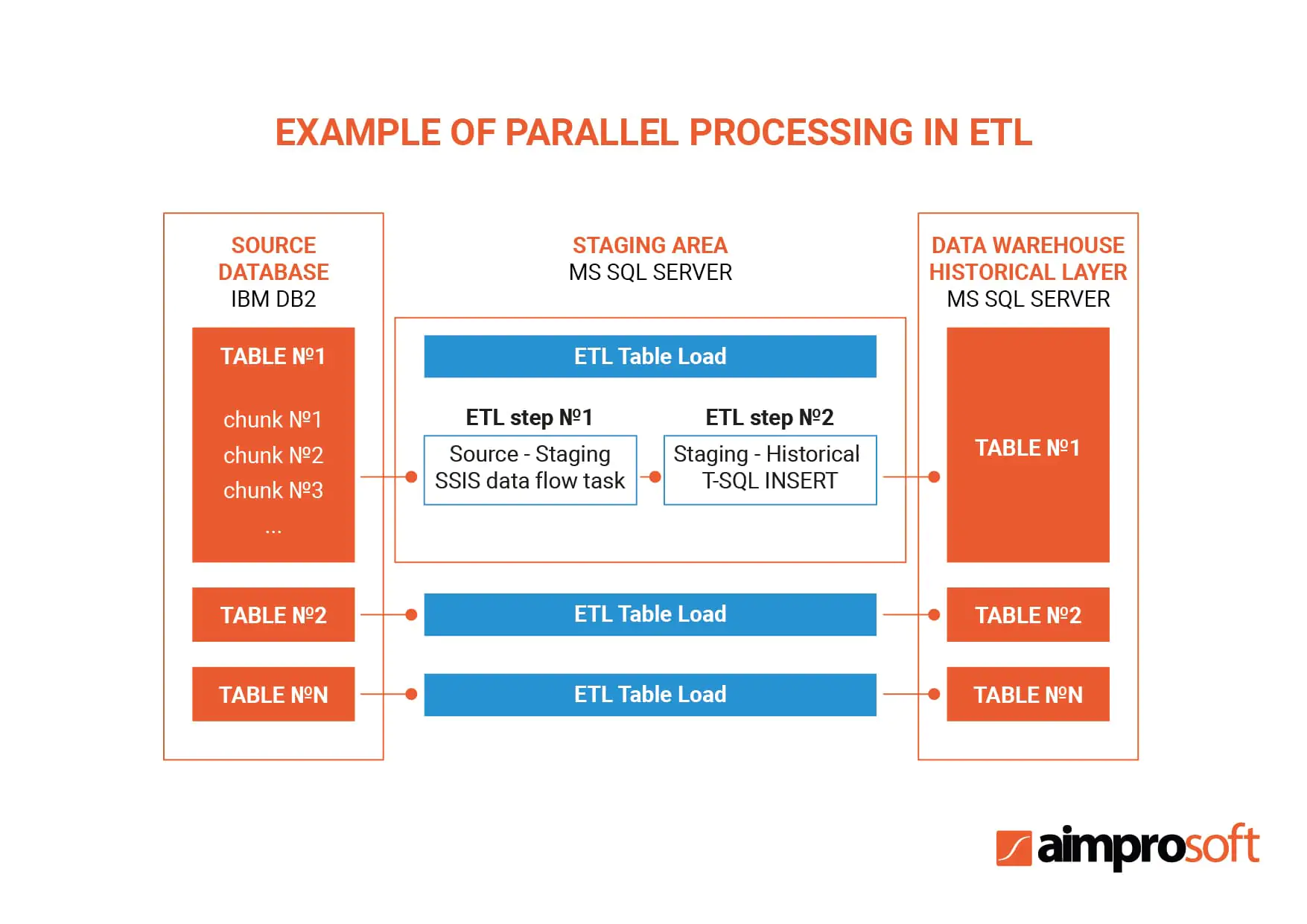
7. Use Parallel Processing Carefully
Parallel processing can improve ETL performance by allowing independent tasks to run at the same time.
For example, data from multiple independent sources can be extracted simultaneously instead of waiting for one source to finish before starting another.
However, running too many tasks in parallel can create resource contention. Engineers should monitor CPU, memory, and network usage to determine an appropriate level of parallelism.
8. Design Pipelines for Scalability
Data volumes can increase quickly as organizations gain customers, transactions, and applications. ETL pipelines should therefore be designed to handle future growth.
Scalable approaches can include cloud infrastructure, distributed processing, partitioned datasets, efficient storage formats, and automated resource management.
A scalable pipeline reduces the need for major redesigns when data requirements increase.
9. Monitor Data Quality and Pipeline Performance
Monitoring should cover both technical performance and data quality.
Important pipeline metrics include:
- Execution time
- Number of records processed
- Failed records
- Data freshness
- CPU and memory usage
- Network traffic
- Pipeline failure frequency
Data quality monitoring can also detect unusual changes in record counts, missing values, or unexpected data patterns.
Combining performance and quality monitoring provides a clearer view of overall pipeline health.
10. Implement Error Handling and Recovery
ETL pipelines can fail because of network problems, database outages, invalid records, API restrictions, or unexpected schema changes.
Reliable pipelines should include logging, retry mechanisms, alerts, and recovery procedures.
Temporary failures can often be handled automatically through retries, while permanent errors should generate detailed logs that help engineers identify and resolve the underlying problem.
11. Manage Schema Changes
Source systems can change over time. New fields may be added, existing columns may be renamed, or data types may change.
Unexpected schema changes can cause pipeline failures if they are not detected.
Schema validation, data contracts, and automated alerts can help engineers identify changes early and update downstream processes accordingly.
12. Automate Testing and Deployment
Automated testing reduces the risk of introducing errors into production pipelines.
Tests can verify:
- Data types
- Record counts
- Transformation logic
- Null values
- Duplicate records
- Source-to-target consistency
- Schema compatibility
Version control and automated deployment processes can further improve reliability by allowing teams to review changes and deploy updates consistently.
Benefits of Following ETL Best Practices
A well-designed ETL environment can provide significant advantages for organizations. High-quality pipelines deliver accurate information while using infrastructure efficiently.
Key benefits include:
- Improved data accuracy
- Stronger security
- Faster processing
- Lower infrastructure costs
- Better scalability
- Easier troubleshooting
- More reliable analytics
- Simplified pipeline maintenance
These benefits help data teams create a stronger foundation for business intelligence and data-driven decision-making.
Conclusion
Effective ETL development requires more than moving information from one system to another. Data engineers need to consider data quality, security, performance, and scalability throughout the entire pipeline lifecycle.

DNS Magazine News Admin shares informative and engaging content covering technology, business, lifestyle, digital marketing, and trending topics. Our goal is to provide readers with useful, reliable, and easy-to-understand information.