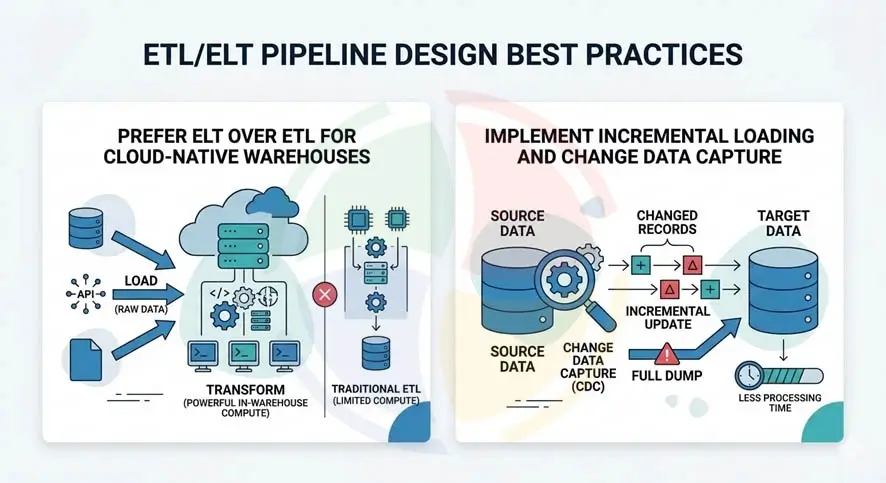
As organizations continue generating massive amounts of data, the need for efficient data management has become more important than ever. Businesses rely on accurate, timely, and well-organized data to make informed decisions, improve operations, and gain a competitive advantage. Extract, Transform, and Load (ETL) processes are the foundation of modern data integration, especially in cloud data warehousing and analytics environments. Following etl best practices helps organizations build reliable, scalable, and secure data pipelines that support business intelligence and advanced analytics.
Cloud platforms have transformed how companies store and process information. Instead of maintaining expensive on-premises infrastructure, businesses now use cloud-based data warehouses to manage growing datasets efficiently. Implementing effective ETL strategies ensures that data remains accurate, consistent, and ready for analysis.
What Is ETL?
ETL stands for Extract, Transform, and Load. It is the process of collecting data from multiple sources, converting it into a standardized format, and loading it into a centralized data warehouse for reporting and analysis.
The ETL process consists of three main stages:
Extract
During extraction, data is collected from various sources such as:
- Databases
- Business applications
- Websites
- APIs
- CRM systems
- ERP software
- Cloud storage platforms
- IoT devices
The objective is to gather complete and reliable information without affecting the performance of source systems.
Transform
Transformation prepares raw data for analysis.
This stage may include:
- Removing duplicate records
- Correcting errors
- Standardizing formats
- Validating data quality
- Combining multiple datasets
- Calculating new values
- Applying business rules
Transformation ensures consistency across the organization.
Load
The final stage loads transformed data into a cloud data warehouse where analysts and business users can access it for reporting, dashboards, and predictive analytics.
Why Cloud Data Warehousing Matters
Cloud data warehouses provide scalable infrastructure that supports growing business needs.
Benefits include:
- Flexible storage capacity
- High performance
- Automatic backups
- Reduced hardware costs
- Improved accessibility
- Faster analytics
- Better collaboration
Cloud platforms enable organizations to process enormous volumes of information without investing heavily in physical infrastructure.
Importance of ETL Best Practices
Following standardized ETL methods improves both data quality and operational efficiency.
Organizations that implement etl best practices benefit from:
- More reliable reporting
- Improved decision-making
- Faster data processing
- Lower maintenance costs
- Better security
- Higher scalability
- Increased system reliability
Well-designed ETL pipelines reduce operational risks while ensuring accurate business intelligence.
Design Scalable Data Pipelines
Scalability should be considered from the beginning of every ETL project.
As businesses grow, data volumes increase rapidly. ETL pipelines should be capable of handling:
- Larger datasets
- More users
- Additional data sources
- Higher processing frequency
- Future business expansion
Building scalable architectures reduces the need for major redesigns later.
Prioritize Data Quality
Poor-quality data can lead to inaccurate reports and poor business decisions.
Data quality improvements should include:
- Duplicate detection
- Missing value handling
- Data validation
- Format standardization
- Error logging
- Data cleansing
Reliable analytics depend on clean, consistent, and trustworthy information.
Automate ETL Workflows
Automation reduces manual work while improving efficiency.
Automated ETL systems can:
- Schedule data extraction
- Monitor pipeline performance
- Generate alerts
- Retry failed jobs
- Produce execution reports
- Validate completed processes
Automation minimizes human error while increasing productivity.
Monitor Pipeline Performance
Continuous monitoring helps identify problems before they affect business operations.
Important metrics include:
- Processing time
- Data volume
- Failed jobs
- Error frequency
- Resource utilization
- System availability
Monitoring tools provide visibility into pipeline health and overall system performance.
Secure Sensitive Data
Security should be integrated throughout the ETL lifecycle.
Recommended security measures include:
- Data encryption
- Access controls
- Authentication
- Audit logging
- Secure API connections
- Network protection
Protecting sensitive customer and business information is essential for maintaining compliance and trust.
Optimize Data Transformation
Transformation often consumes the largest portion of ETL processing time.
Optimization strategies include:
- Eliminating unnecessary calculations
- Filtering unwanted records
- Processing only changed data
- Using parallel processing
- Reducing redundant operations
Efficient transformations improve performance while lowering cloud computing costs.
Use Metadata Management
Metadata describes the structure, origin, and purpose of data.
Proper metadata management helps organizations:
- Track data lineage
- Improve documentation
- Simplify troubleshooting
- Support governance
- Maintain compliance
Clear documentation also assists new team members in understanding existing ETL pipelines.
Implement Data Validation
Validation ensures that loaded data matches expected business requirements.
Validation checks may include:
- Record counts
- Data completeness
- Field accuracy
- Value consistency
- Referential integrity
Early detection of problems prevents inaccurate reporting.
Backup and Disaster Recovery
Reliable ETL systems should include disaster recovery planning.
Essential practices include:
- Regular backups
- Version control
- Recovery testing
- Replication
- High availability architecture
Business continuity depends on rapid recovery after unexpected failures.
Cloud Analytics Benefits
Cloud data warehouses enable organizations to perform advanced analytics using centralized information.
Common applications include:
- Business intelligence dashboards
- Financial reporting
- Customer behavior analysis
- Sales forecasting
- Supply chain optimization
- Marketing performance measurement
Organizations gain faster insights while supporting better strategic decisions.
Emerging ETL Trends
Modern ETL continues evolving alongside cloud technologies.
Current trends include:
- AI-assisted data integration
- Machine learning for anomaly detection
- Real-time streaming pipelines
- Serverless ETL architecture
- Data lake integration
- Automated data quality monitoring
These innovations improve efficiency while supporting larger and more complex business environments.
Conclusion
Cloud data warehousing has become an essential component of modern business intelligence, enabling organizations to store, process, and analyze massive amounts of information efficiently. A well-designed ETL process ensures that data remains accurate, secure, and ready for decision-making. By focusing on scalability, automation, security, monitoring, validation, and data quality, organizations can build reliable data pipelines that support long-term growth.

DNS Magazine News Admin shares informative and engaging content covering technology, business, lifestyle, digital marketing, and trending topics. Our goal is to provide readers with useful, reliable, and easy-to-understand information.