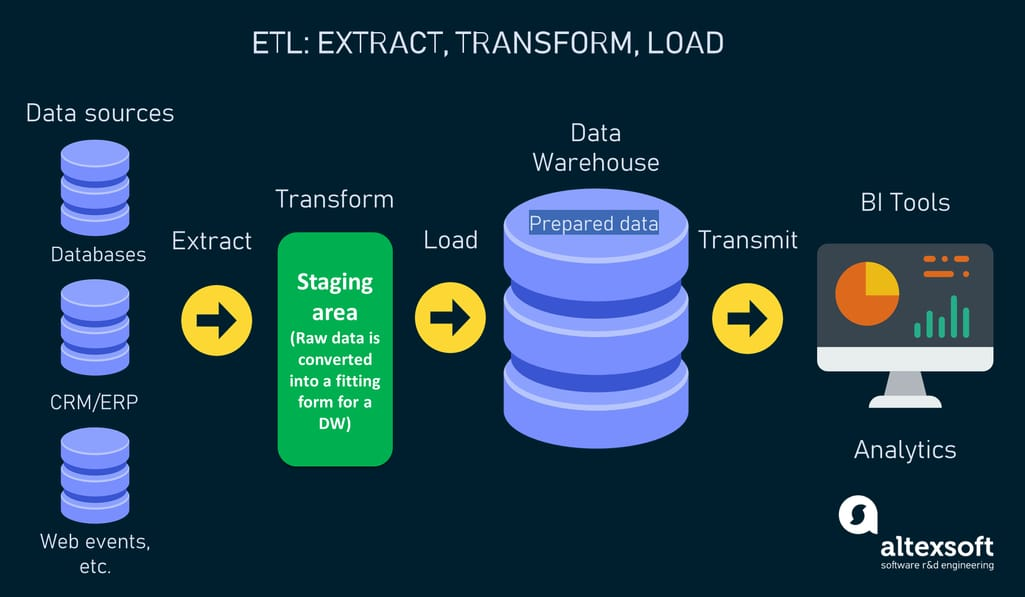
In today’s digital landscape, organizations rely on data to make informed decisions, improve customer experiences, and gain a competitive advantage. However, collecting data from multiple sources is only the first step. The real challenge lies in integrating that data accurately and efficiently. This is where ETL (Extract, Transform, Load) becomes essential. ETL helps businesses gather raw information, clean and transform it, and load it into a centralized system for analysis.
Building an efficient ETL pipeline requires more than selecting the right tools. It involves careful planning, strong data governance, and continuous optimization. By following ETL Best Practices, organizations can reduce processing time, improve data accuracy, and create reliable pipelines that support business intelligence and analytics.
What Is ETL?
ETL stands for Extract, Transform, and Load, a three-step process used to combine data from different sources into a single repository.
- Extract: Data is collected from databases, APIs, cloud applications, spreadsheets, and other systems.
- Transform: The extracted data is cleaned, validated, standardized, and formatted according to business requirements.
- Load: The processed data is transferred into a data warehouse, data lake, or analytics platform where it can be used for reporting and decision-making.
An effective ETL process ensures that organizations work with consistent and trustworthy information.
Why ETL Best Practices Matter
Poorly designed ETL pipelines often lead to slow processing, duplicate records, missing values, and inaccurate reports. These issues can negatively impact business decisions and reduce operational efficiency.
Implementing proper ETL strategies provides several advantages:
- Faster data processing
- Higher data quality
- Better reporting accuracy
- Improved scalability
- Reduced maintenance costs
- Enhanced security
- Reliable business intelligence
Businesses that invest in optimized ETL workflows are better prepared to handle growing volumes of data while maintaining consistent performance.
Start with Clear Business Requirements
Every successful ETL project begins with understanding business objectives. Before developing a pipeline, identify what data is needed, where it comes from, and how it will be used.
Questions to consider include:
- What are the primary data sources?
- How frequently should data be updated?
- Who will use the reports?
- What data quality standards must be maintained?
- What performance expectations exist?
Planning these requirements early helps avoid unnecessary redesigns later.
Prioritize Data Quality
High-quality data is the foundation of successful analytics. Even the most advanced dashboards cannot produce accurate insights if the underlying information contains errors.
To improve data quality:
- Remove duplicate records.
- Validate mandatory fields.
- Handle missing values appropriately.
- Standardize naming conventions.
- Normalize date and currency formats.
- Verify data accuracy before loading.
Quality checks should be integrated into every stage of the ETL workflow rather than performed only at the end.
Optimize Data Extraction
Efficient extraction minimizes the workload on source systems while reducing overall processing time.
Instead of extracting complete datasets every time, businesses should use incremental extraction whenever possible. This approach transfers only newly added or modified records, making the process significantly faster.
Other optimization techniques include:
- Filtering unnecessary data.
- Using indexed queries.
- Scheduling extraction during off-peak hours.
- Compressing large datasets before transfer.
These methods reduce network traffic and improve system performance.
Build Efficient Transformation Logic
Data transformation is often the most resource-intensive stage of ETL. Poor transformation design can slow the entire pipeline.
Best practices include:
- Eliminate unnecessary calculations.
- Break complex transformations into smaller tasks.
- Reuse transformation components.
- Apply validation rules consistently.
- Document transformation logic for future maintenance.
Simplifying transformation processes improves both speed and reliability.
Automate ETL Workflows
Manual execution increases the likelihood of human error and consumes valuable time. Modern ETL systems should be fully automated whenever possible.
Automation allows organizations to:
- Schedule recurring jobs.
- Trigger workflows automatically.
- Send notifications after execution.
- Retry failed tasks.
- Generate performance reports.
Automated pipelines improve consistency while reducing administrative effort.
Monitor Pipeline Performance
Monitoring is essential for maintaining healthy ETL systems. Without continuous observation, small performance issues can develop into major operational problems.
Important metrics include:
- Job completion time
- Failed records
- Processing speed
- CPU and memory usage
- Data transfer rates
- Error frequency
Real-time monitoring enables technical teams to identify bottlenecks before they affect business operations.
Implement Strong Error Handling
Unexpected failures can occur due to network interruptions, corrupted files, system outages, or changes in source data.
A robust ETL pipeline should include:
- Detailed error logs
- Automatic retry mechanisms
- Exception alerts
- Backup recovery plans
- Validation checkpoints
Instead of stopping the entire process, pipelines should isolate problematic records while allowing valid data to continue processing.
Secure Sensitive Data
Many organizations process confidential customer information, financial records, healthcare data, and business documents through ETL workflows.
Security should include:
- Data encryption during transfer
- Secure authentication
- Role-based access control
- Audit logging
- Compliance with industry regulations
- Regular security reviews
Strong security practices help prevent unauthorized access while ensuring regulatory compliance.
Design for Scalability
Business data grows rapidly over time. ETL pipelines should be designed to handle increasing workloads without requiring complete redevelopment.
Scalable systems should support:
- Additional data sources
- Higher transaction volumes
- Cloud-based storage
- Parallel processing
- Distributed computing
Planning for future growth saves time and reduces infrastructure costs.
Keep Documentation Updated
Documentation simplifies maintenance and knowledge transfer.
Good ETL documentation should include:
- Source systems
- Destination databases
- Workflow diagrams
- Transformation rules
- Scheduling details
- Error-handling procedures
- Version history
Well-maintained documentation allows new team members to understand pipelines quickly and reduces troubleshooting time.
Test Before Deployment
Testing ensures that ETL workflows perform correctly before reaching production environments.
Essential testing includes:
- Functional testing
- Performance testing
- Integration testing
- Data validation
- Security testing
- User acceptance testing
Thorough testing minimizes deployment risks and improves long-term reliability.
Continuously Improve Your ETL Pipeline
Technology and business requirements constantly evolve. ETL Best Practices pipelines should be reviewed regularly to identify opportunities for improvement.
Continuous optimization may include:
- Updating outdated scripts
- Improving SQL queries
- Removing unused workflows
- Upgrading ETL tools
- Increasing automation
- Enhancing monitoring systems
Regular maintenance ensures consistent performance as data volumes continue to grow.
Conclusion
Reliable data integration is critical for organizations that depend on accurate reporting and business intelligence. Building efficient ETL pipelines requires careful planning, strong data quality controls, automation, security, and continuous performance monitoring. By implementing ETL Best Practices, businesses can create faster, more reliable data integration processes that support informed decision-making and future growth.

DNS Magazine News Admin shares informative and engaging content covering technology, business, lifestyle, digital marketing, and trending topics. Our goal is to provide readers with useful, reliable, and easy-to-understand information.